In June 2025, the Federal Government read proposed Bill C-2 (aka The Strong Borders Act) for the first time in the House of Commons.
This proposed bill was highly scrutinized due to controversial policies surrounding lawful access and digital surveillance powers, resulting in a bill that would have been difficult to pass quickly. As a result, Bill C-2 was paused, and Bill C-12 was introduced.
Proposed Bill C-12 eliminates the controversial policies from proposed Bill C-2 surrounding lawful access and digital surveillance powers that would allow law enforcement powers to basic subscriber information from any provider in Canada, without a warrant.
Additionally, proposed guidelines that would have restricted cash payments, donations and deposits over $10,000 and all third-party deposits (for non-bank businesses) were originally tabled in C-2, but left out of Bill C-12 as well due to their controversial nature. However, although these restrictions on cash transactions and deposits did not make their way into Bill C-12, they did not disappear entirely and have resurfaced in the 2025 Fall Budget (see our post on this topic here).
Pushing Bill C-2 forward would have been difficult because of these highly critiqued propositions and thus, the Bill has now been split into an “easier to implement version”…enter proposed Bill C-12.
Want to learn more? Below our experts have put together a recap for you of important things you need to know regarding AML and the new proposed Bill C-12:
➡️ Higher FINTRAC penalties and new cumulative caps are still expected.
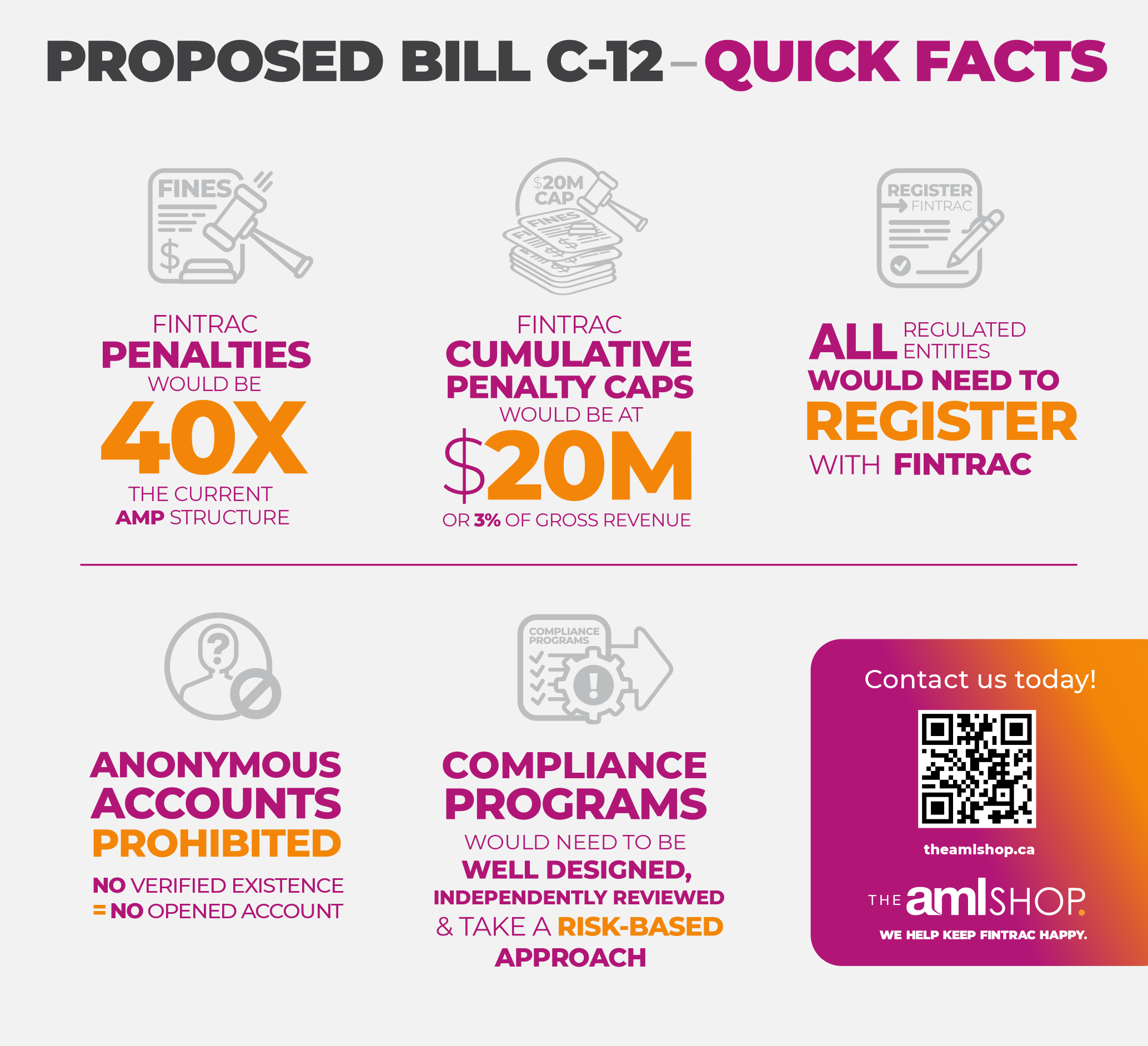
If enacted, this bill would authorize FINTRAC to penalize up to 40X the current penalty structure. This means maximum penalties for very serious offences could skyrocket up to $20 million per offence. For cumulative violations, there would be a cap set at $20 million or 3% of gross revenues.
As you can imagine, for high revenue entities - multiple violations could result in penalties of hundreds of millions of dollars or higher 💸
➡️ FINTRAC enrollment requirements would still broaden by requiring universal enrollment.
All PCMLTFA reporting entities would have to be enrolled with FINTRAC and maintain their enrollment. If you don’t enroll or maintain enrollment, you could face consequences which could even potentially include the possibility of criminal charges.
FINTRAC’s current registration processes take months now, with only several thousand registrants. Prepare for a far longer delay when 30,000 businesses have to go through the enrollment processes.
Keep fear of regulators at bay. We can help you, just like we have helped hundreds of other companies and MSBs in their registration and enrollment process. 🤝
➡️ Anonymous Accounts prohibition.
Although this may seem obvious and already enforced, there is more to it than you might imagine. This amendment to the PCMLTFA would prohibit any anonymous accounts from being opened. However, if you dig under the surface, what this would really mean for regulated entities is that an account is deemed anonymous if the account opener cannot be verified under existing identity verification requirements.
No verified existence = no opened account 🚫
➡️ More scrutiny of compliance programs and effectiveness reviews.
FINTRAC would take a harder stance on its review of compliance programs and their component elements. FINTRAC would have the ability to levy fines and penalties where compliance programs and documents may exist but are perhaps not in FINTRAC’s judgement of being effective in mitigating money laundering, terrorist financing and sanctions risks.
The current standard of having a documented, written compliance program would no longer cut it. It would have to be effective…not just tested routinely for its effectiveness.
And, failure to meet FINTRAC’s new compliance program standards in this proposed regime could result in a serious violation and cost your company millions of dollars in penalties.
The catch is understanding and knowing exactly what regulators are looking for here…as we predict, it will be highly subjective and industry specific. Remember, our experts have been involved in numerous FINTRAC exams and we have seen how things typically play out during an examination. Our in-depth experience in this area can help evaluate the benchmarks appropriate for your business and industry.
Because of the subjective nature of these proposed requirements, having an AML Shop expert on your side could save you a ton of headache. 💆
Conclusion:
Despite provisions from proposed Bill C-2 dropping off the current radar in the new revised legislation, select key elements remain proposed in Bill C-12 to help increase Canada’s efforts against financial crime and AML compliance.
Namely in:
🇨🇦 Significantly increasing Administrative Monetary Penalties
🇨🇦 The broadening of FINTRAC registration requirements
🇨🇦 Prohibiting anonymous accounts
🇨🇦 More scrutiny of compliance programs and effectiveness reviews
Our AML expert team has worked on volumes of engagements for all reporting entity types and can help you navigate how your business handles these potential new changes with accuracy and ease. Reach out to our team today to get started.
We Help Keep FINTRAC Happy.